
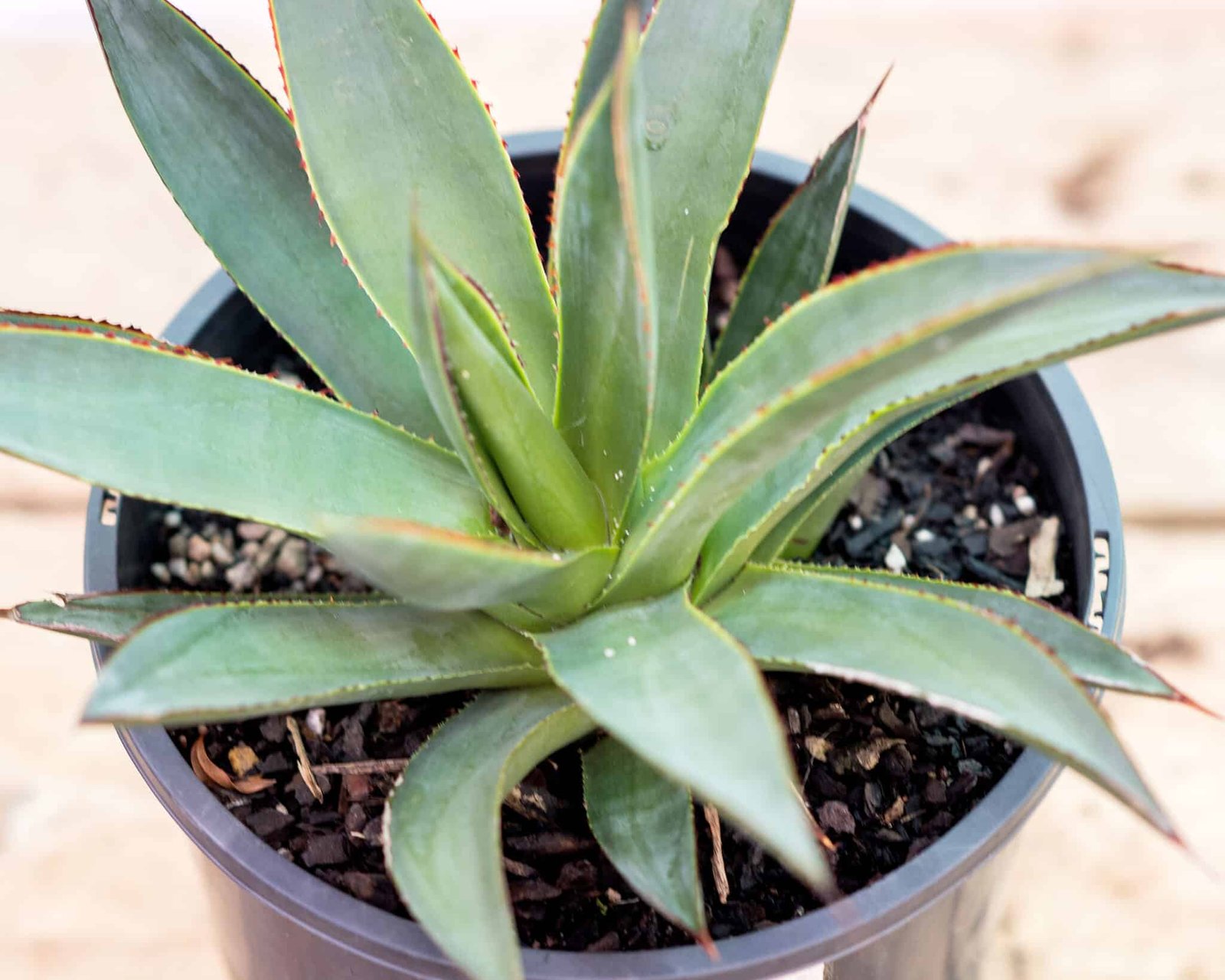
Agave ‘Blue Glow’ is a highly prized hybrid known for its slow-growing, solitary, and perfectly symmetrical rosette. It is widely considered one of the most beautiful small agaves for Australian landscapes. The leaves are firm, elegant, and a striking chalky blue-green colour.
The “glow” that gives this plant its name comes from its spectacular margins (edges). Each leaf is framed by a thin, translucent band of red and golden-yellow. When the plant is backlit by the morning or late afternoon sun, these edges appear to illuminate, creating a luminous halo effect around the rosette. Unlike many other agaves, ‘Blue Glow’ remains relatively compact, typically reaching about 60cm wide and 60cm high, making it a “polite” choice for smaller gardens or feature pots.
Care Tips
-
Position: Performs best in full sun to light shade. In very hot inland Australian climates, some light afternoon shade can prevent the leaf tips from scorching, but full sun is required to intensify the “glow” on the leaf margins.
-
Climate: Extremely hardy and versatile. It is drought-tolerant once established and can handle light frosts. In colder, frost-prone regions, it is best planted in a protected spot or a pot that can be moved.
-
Soil: Requires excellent drainage. Use a specialised succulent and cacti potting mix if planting in containers. In the garden, ensure the soil is gritty and does not hold water, as the plant is susceptible to heart rot in soggy conditions.
-
Watering: Very low water requirements. Water occasionally during the heat of summer, but allow the soil to dry out completely between waterings. During winter, it requires almost no supplemental water.
-
Fertilising: Apply a slow-release, low-nitrogen fertiliser specifically for succulents in early spring to encourage steady, healthy growth.
-
Maintenance: Unlike many other agaves, ‘Blue Glow’ rarely produces “pups” (offsets), meaning it maintains its solitary, clean shape without the need for thinning.
-
Safety: While it lacks the aggressive side-spines of some agaves, it does have a sharp terminal spine at the tip of each leaf. These can be nipped off with pliers if the plant is located near a walkway or where children play.