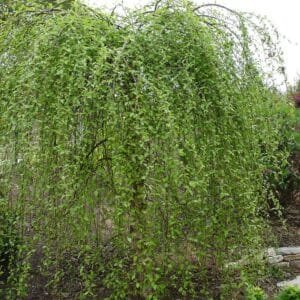
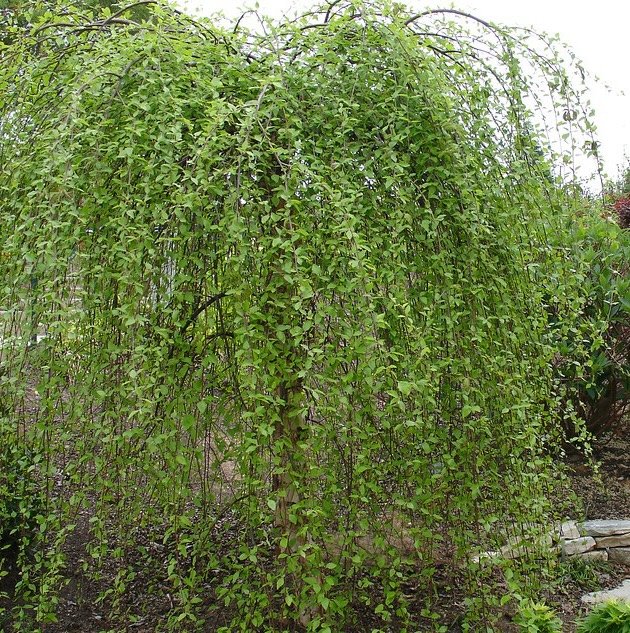

The Weeping River Birch is a relatively recent and highly prized addition to Australian arboriculture. Unlike the upright River Birch, ‘Summer Cascade’ has a distinctively prostrate or weeping habit. If staked, it can be grown into a beautiful specimen tree with branches that flow all the way to the ground like a green waterfall; if left unstaked, it acts as a spreading, arching groundcover. The foliage is a lush, diamond-shaped green that turns a lovely butter-yellow in autumn before dropping to reveal the tree’s architectural skeleton.
One of its most captivating features is the ornamental bark. As the tree matures, the bark on the trunk and older branches begins to flake and peel in papery layers, revealing a palette of cream, tan, and salmon pink. This provides incredible visual interest throughout the winter months. Because it is a variety of the River Birch, it is much more heat-tolerant and resistant to the Bronze Birch Borer than the traditional Silver Birch, making it a much more reliable choice for the Australian climate.
Care Tips
-
Position: Thrives in full sun to part shade. It loves a position where its roots can stay cool and moist, while its canopy enjoys the sun.
-
Climate: Well-suited to temperate and cool-temperate regions of Australia. It is very frost-hardy but also handles the humidity of the east coast better than most other Birch species.
-
Soil: Prefers moist, slightly acidic, and well-drained soils. As the name “River Birch” suggests, it is much more tolerant of wet or heavy soils than other birches, though it should not be left in stagnant water.
-
Watering: High water requirements, especially during the establishment phase and over hot Australian summers. It is not a drought-tolerant tree and will show stress (leaf drop) if allowed to dry out completely.
-
Fertilising: Apply a balanced, slow-release fertiliser in early spring just as the new buds begin to break.
-
Pruning: Pruning is generally only required to maintain the desired shape or to clear the “skirt” of the tree off the ground. Always prune in late summer or autumn to avoid “bleeding” sap, which occurs if cut in spring.
-
Maintenance: A thick layer of organic mulch around the base is essential to retain soil moisture and keep the root zone cool during heatwaves.
Landscape Use Betula nigra ‘Summer Cascade’ is a premier choice for a focal point in a medium-sized garden or near a water feature like a pond or stream. Its weeping form makes it a beautiful addition to a large Stump pot on a spacious patio, where its peeling bark can be appreciated up close. It can also be used effectively in a wide Divider Trough to create a soft, cascading green screen that changes beautifully with the seasons.