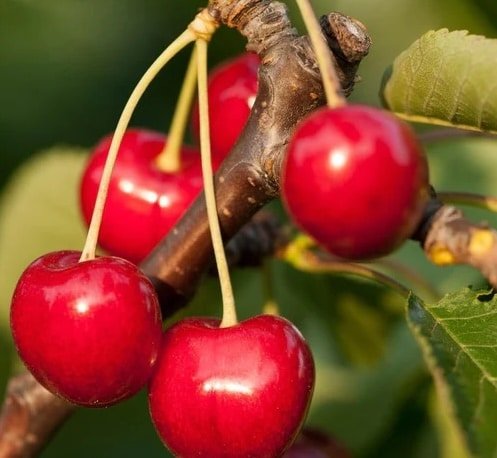
The ‘Stella’ cherry is a revolutionary variety that changed home orcharding forever. Before its development in the late 1960s, most cherry trees required a second variety nearby for cross-pollination. ‘Stella’ was the first self-fertile sweet cherry, making it possible to grow a heavy crop from a single tree in a small garden. It is a vigorous, upright deciduous tree that produces a spectacular show of white spring blossoms.
The fruit is large and heart-shaped with a glossy, deep red skin. The flesh is firm, dark red, and remarkably juicy with a rich, sweet flavour. In Australia, ‘Stella’ is a backyard favourite because it is a reliable cropper and the fruit is quite resistant to skin cracking caused by rain. It also serves as an excellent universal pollinator for other cherry varieties that are not self-fertile.
Care Tips
-
Position: Requires a position in full sun to ensure the fruit reaches its maximum sweetness and develops its characteristic deep colour.
-
Climate: Best suited to Cool Temperate regions. Like most sweet cherries, it has a high winter chill requirement (around 600–800 hours) to ensure a successful fruit set.
-
Pollination: Self-fertile. You do not need another tree to get fruit, although it can help increase the yield of other cherry varieties planted nearby.
-
Soil: Thrives in deep, fertile, and well-drained soil. Cherries are notoriously sensitive to waterlogging, so avoid planting in low-lying areas of the garden.
-
Watering: Provide consistent and deep watering during the spring and summer months. Mulching around the base of the tree is vital to maintain even soil moisture, which helps prevent the fruit from splitting.
-
Fertilising: Apply a balanced fruit tree fertiliser in early spring just as the buds start to swell.
-
Pruning: To reduce the risk of fungal or bacterial diseases like gummosis, it is best to prune ‘Stella’ in late summer after the harvest is finished, rather than in the middle of winter.
-
Harvest: Fruit typically ripens in early to mid-summer (late December to early January in Australia), usually about a week or two before ‘Lapins’.