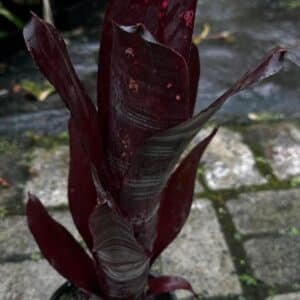
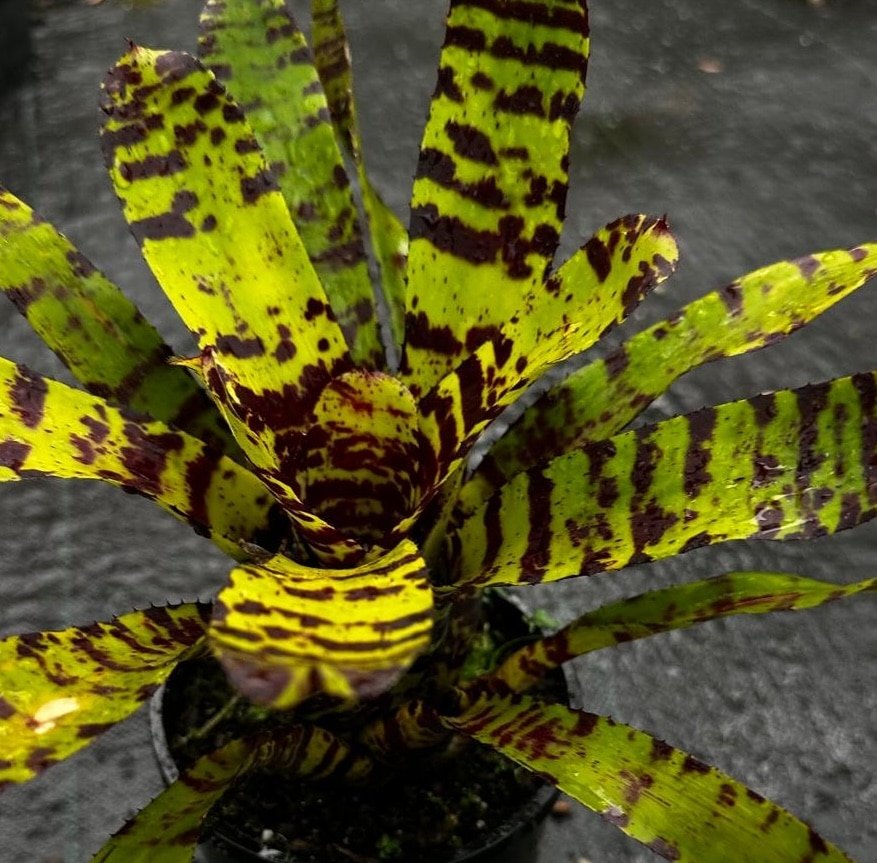
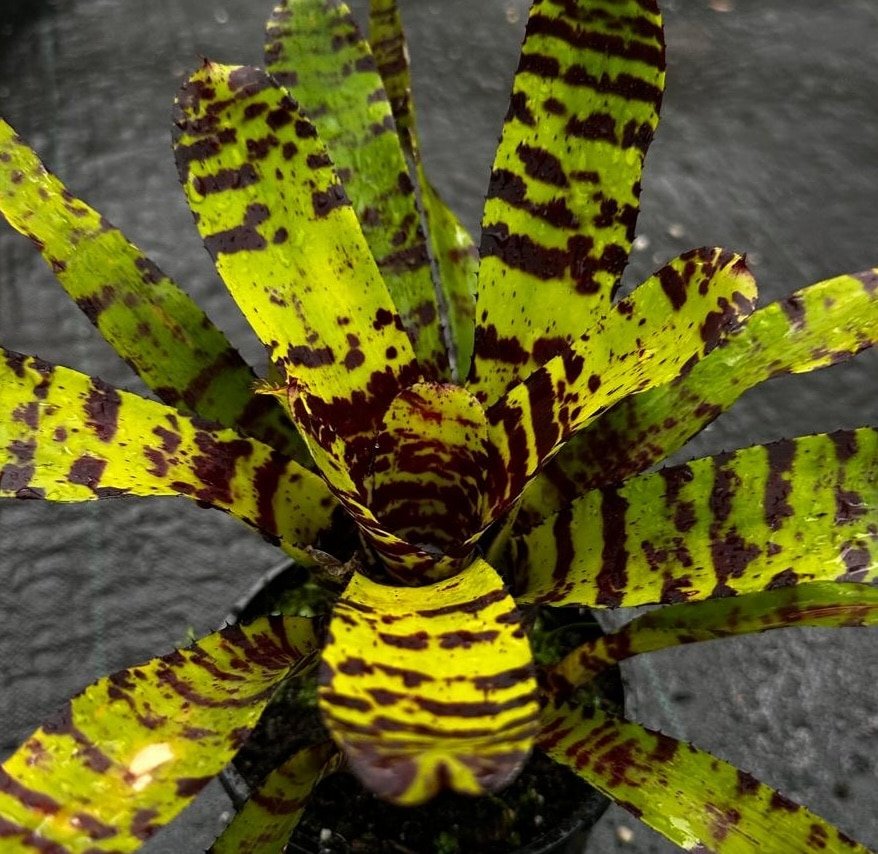
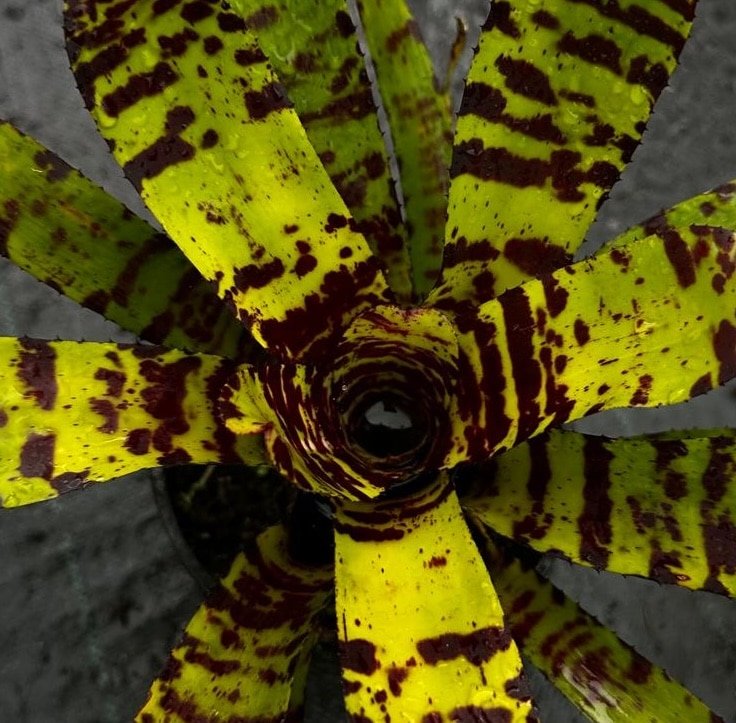
‘Storm Blade’ is a modern Neoregelia hybrid (likely a Chester Skotak creation or similar Thai hybrid) prized for its dramatic, “stormy” appearance. It forms a compact, relatively flat rosette of narrow, lance-shaped leaves. The foliage is a base of mid-to-bright green, but it is heavily overlaid with intense, dark red-to-burgundy spotting, speckling, and broken horizontal bands. This gives the plant a serrated, almost aggressive visual texture that lives up to its name.
Unlike many other bromeliads, ‘Storm Blade’ is grown almost entirely for its spectacular year-round foliage. When it reaches maturity and prepares to flower, it does not produce a tall spike; instead, it develops a cluster of small, delicate violet-blue flowers deep within its central water-holding cup. After flowering, the mother plant will slowly transition its energy into producing “pups” at its base, allowing the colony to expand.
Care Tips
-
Position: Prefers bright, indirect light or filtered sunlight. To achieve the most intense red “storm” markings, the plant needs high light levels, but it should be protected from the scorching midday Australian sun, which can bleach or burn the leaves.
-
Climate: Well-suited to Subtropical and Warm Temperate regions. It is relatively hardy but should be protected from frost. If grown in cooler climates, it makes an exceptional indoor plant near a bright window.
-
Watering: Like all tank-type bromeliads, it has a central “vase.” Keep this central cup filled with fresh water (rainwater is best). Flush the old water out every week or two to prevent stagnation. The soil or potting medium should be kept slightly moist but never soggy.
-
Soil: Must be planted in a very free-draining medium. Use a specific bromeliad mix or a blend of orchid bark, charcoal, and perlite. Standard garden soil will suffocate the roots.
-
Fertilising: Requires very little food. A weak, half-strength liquid fertiliser can be applied to the foliage or soil during spring and summer. Avoid putting high-strength fertiliser directly into the central cup, as this can cause salt burn.
-
Propagation: Once the mother plant has finished flowering, look for small offsets (pups) emerging from the base. Wait until these are about one-third to half the size of the mother plant before cutting them away with a clean knife to repot.
-
Maintenance: Remove any dead or damaged lower leaves to keep the rosette looking tidy and to allow for better airflow around the base of the plant.